Top 10 Stainless Steel Water Bottle Manufacturers
Choosing a Stainless Steel Water Bottle manufacturer involves more than comparing prices or polished product photos. Buyers should examine steel grade, wall thickness, lid construction, insulation performance, and the finish around seams. Small details matter. A cap that leaks in a backpack can undermine an otherwise well-made bottle.
Engineering professor and author Henry Petroski is associated with the concise design principle, “Form follows failure.” It offers a useful lens for assessing reusable bottles: look at how products withstand drops, repeated opening, washing, and temperature changes. A manufacturer’s test methods and quality checks deserve attention, not just its catalog claims. Ask how it verifies capacity, leak resistance, and thermal performance, and whether it can provide clear specifications or samples. These checks do not guarantee a perfect product, but they help separate evidence from marketing.
This Top 10 Stainless Steel Water Bottle Manufacturers guide compares suppliers through practical considerations, including production capability, customization, quality control, and communication. Some companies may excel at large orders, while others may offer more flexible designs or lower minimum quantities. There is no single best choice for every buyer. Even a detailed comparison has limits: factory capabilities and product quality can vary by model and order. Treat the shortlist as a starting point, then confirm current specifications directly with each manufacturer before making a decision.
Stainless Steel Water Bottles: Materials, Designs, and Uses
Stainless steel bottles commonly use 304-grade steel, often called 18/8 for its chromium and nickel content; some designs use 316-grade steel for improved corrosion resistance. Material choice affects cost, weight, and durability. It is not a simple “higher grade is always better” decision. Buyers should also check the inner surface, welds, lid materials, and food-contact documentation, because a premium-looking exterior cannot verify what touches the drink.
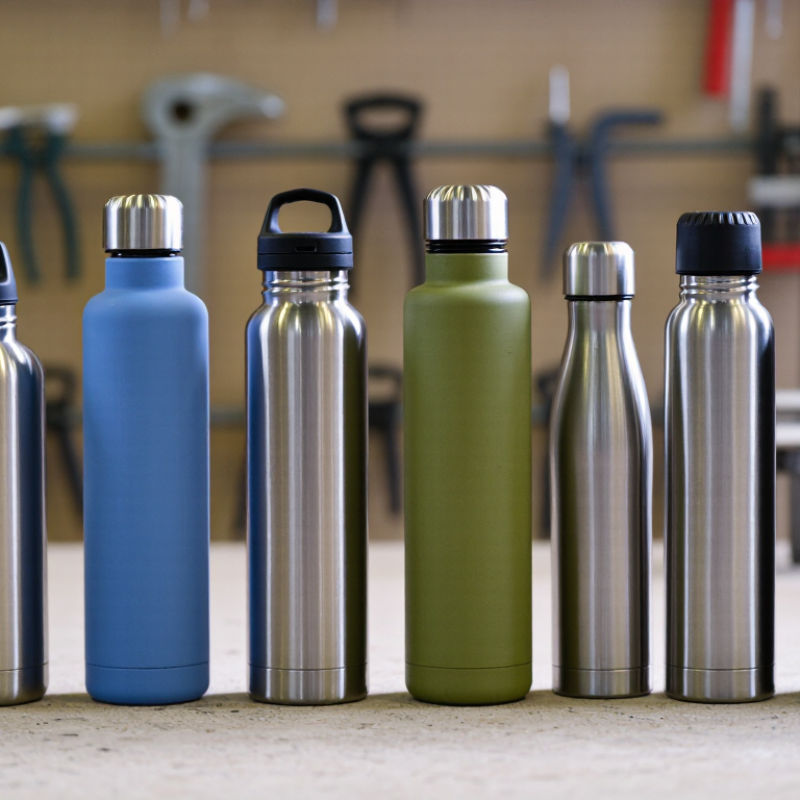
Design changes how a bottle works in daily life. Double-wall vacuum construction helps retain drink temperature, while single-wall bottles are lighter and easier to pack. A narrow mouth can reduce spills but make cleaning awkward; a wide mouth fits ice cubes and a bottle brush. Details matter. The right lid depends on whether the bottle is used at a desk, on a commute, or outdoors. Some designs promise convenience but add parts that are easy to lose.
Demand offers useful context for manufacturers. Grand View Research’s 2023 Reusable Water Bottle Market report valued the global market at USD 8.4 billion in 2022 and forecast 4.4% annual growth through 2030. Meanwhile, the International Stainless Steel Forum reported 58.4 million tonnes of global stainless steel production in 2023. These figures describe broad markets, not bottle quality. Buyers still need practical testing: leak checks, repeated washing, and careful inspection of seams can reveal shortcomings that product photos miss.
How Stainless Steel Water Bottles Are Manufactured
Stainless steel water bottles begin as thin coils, typically made from food-contact-grade steel. The World Stainless Association reported 58.4 million tonnes of global stainless-steel crude-steel production in 2023. That figure describes the wider steel industry, not bottle output, but it shows the scale of the material supply. At a factory, coils are cut into circular blanks, then pressed into shape through deep drawing or related forming methods. The metal can look deceptively simple.
For insulated bottles, manufacturers form inner and outer shells, join them at the neck, and remove air from the space between them to create a vacuum layer. Welds and seams need close inspection; a small defect can compromise insulation or cause a leak. The surface is then cleaned and finished, while quality checks may include dimensional measurements, leak testing, and temperature-retention testing. Processes vary by design, and a polished exterior alone cannot prove consistent internal quality.
Tips: Check that a maker explains its steel grade, welding checks, and leak-testing process. Ask how performance is tested, too. Clear answers matter. A detail that is often overlooked: finishing can hide marks, so inspection should happen before final polishing.
Key Factors for Evaluating Bottle Manufacturers
Top 10 Stainless Steel Water Bottle Manufacturers
Evaluating a stainless steel bottle manufacturer takes more than comparing catalog photos. Ask which steel grade is used for the body and whether material records can be matched to production batches. A polished sample can look flawless under showroom lights, but weld seams, threads, and the inner base deserve close inspection. Small details matter.
Request test information for leaks, insulation performance, and repeated lid opening. Results should explain how samples were tested, not just display a pass mark. Check that seals sit evenly and do not shift when the cap is tightened. If possible, handle a sample filled with hot water, then inspect the exterior and lid after several hours. One test is not enough.
Production controls matter too. Ask how incoming steel, coating, printing, and finished bottles are checked, and whether inspection records are available. Clarify minimum order quantities, production capacity, sample lead times, and how defects are handled. Clear answers are useful evidence of a dependable process. Still, a factory visit or detailed report cannot predict every issue in a large order. Keep agreed specifications in writing, and compare a pre-production sample with delivered goods.
Profiles of 10 Stainless Steel Water Bottle Manufacturers
These ten manufacturer profiles highlight different production strengths, not a universal ranking. Ask for recent samples, material specifications, and process details before comparing suppliers. A high-volume producer uses automated forming lines and suits retailers needing consistent dimensions across large orders. A small-batch workshop offers flexible colors and lid changes, though unit costs may rise. An insulation specialist focuses on double-wall vacuum construction; inspect seam quality and heat-retention test methods.
A food-contact-focused factory documents steel grades, surface finishing, and batch traceability. A customization shop handles logos, powder coating, and packaging, but new tooling can slow a launch. A recycled-material producer can provide sourcing records; recycled content should be stated clearly, not assumed. A sports-bottle maker designs wide mouths and carry loops for frequent refills.
A children’s bottle specialist prioritizes lighter bodies, simple lids, and replaceable seals. An export-oriented plant may coordinate cartons and shipping schedules, yet lead times still need written confirmation. A parts-focused manufacturer keeps caps and gaskets available, extending practical product life.
Small details matter. Catalog descriptions can look more certain than production reality, so compare written specifications with samples and ask how defects are handled.
Comparing Manufacturers by Products, Markets, and Capabilities
Comparing ten stainless steel water bottle manufacturers means looking beyond catalogue photos. Product ranges may include single-wall bottles, insulated tumblers, sports lids, and narrow-neck designs. These differences affect weight, temperature retention, cleaning, and compatibility with cup holders. Ask for material specifications and sample units; check welds, lid fit, and finish under ordinary use. Small details matter.
Markets shape what each manufacturer can supply. A company serving outdoor retailers may prioritize rugged coatings and leak-resistant caps, while a promotional supplier may offer more colors and printing options. Manufacturing capabilities also vary: some factories handle forming, polishing, and assembly in-house; others rely on outside partners. Ask about production capacity, quality checks, customization limits, and typical lead times. Request documented test methods, not just broad performance claims. Still, a neat comparison sheet can hide uneven sample quality, and I would not treat one successful prototype as proof of consistent production. Recheck samples from a later run when possible. A little inconvenient, but useful. Manufacturers should explain how they inspect bottle bodies, lids, and finished surfaces before shipment.

 +86-13586927333
 CONTACT NUMBER
 CONTACT NUMBER